The Caregiver's Inbox: Running a Parent's Prescription Life From Another State

The first sign is usually small. A refill that never got called in. A delivery notice for a package sitting on a porch in another state. A pharmacist leaving a voicemail for a woman who no longer checks her phone. By the time an adult child realizes how much of a parent's medication routine depends on local legwork, something has already slipped.
Long-distance caregiving has become ordinary in the United States, and medication coordination is its most relentless task. Refills run on their own schedules. Prior authorizations expire without warning. Mail-order pharmacies ship on their own timelines, to addresses that may or may not have someone home. What follows is a practical account of the infrastructure that makes remote oversight work — and the shortcuts that quietly undermine it.
The Inbox Is Not the Problem; the Permissions Are
A caregiver's email folder fills quickly: shipping confirmations, refill reminders, prescriber office portals, insurer notices. Yet none of that visibility produces authority. Being able to see a pharmacy account does not mean you can speak to a pharmacist about a prescription, and it certainly does not mean a physician's office will discuss a diagnosis with you.
The foundation is a signed HIPAA authorization naming you explicitly, held by each prescriber's practice and, where relevant, the pharmacy. Ask for the practice's own form rather than a generic template, keep a scanned copy in your files, and note the expiration date — many are valid for a defined period and lapse silently. A health care power of attorney is a separate and stronger document; it governs decision-making if your parent cannot make decisions, and it is worth having even if the authorization is already in place.
Pharmacy Account Permissions Vary More Than You Would Expect
Online pharmacies handle delegated access in different ways. Some allow a caregiver to be added as an authorized contact who can discuss orders and refills but cannot alter payment details. Others offer full account delegation with its own login. Mail-order arms of large insurers may require a form signed by the patient and processed by mail, which can take weeks.
Before relying on any arrangement, confirm three things in writing or in a saved chat transcript: what you can see, what you can change, and who else has access. Then document the account recovery details somewhere your parent's files can be found — not only in your own password manager, because a caregiver who is hospitalized is a second emergency waiting to happen.
Delivery Day Is the Weak Point
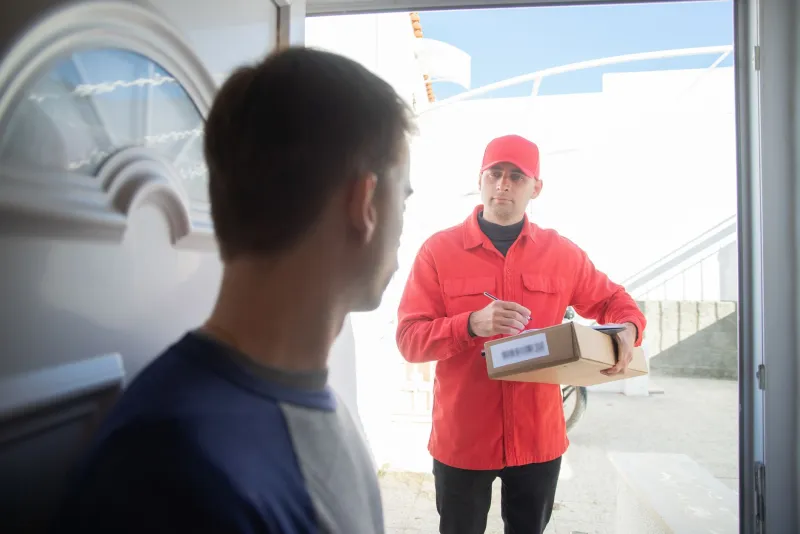
A prescription that requires an adult signature cannot be left with a doorman who is not authorized, and it cannot be signed by a neighbor as a favor. If your parent's building has a front desk, find out whether staff will accept packages and under what conditions. If not, arrange delivery to a location where someone is reliably present, or set the order to ship on a day a home aide visits.
Theft is the other half of the problem. Porch piracy is opportunistic and seasonal, and a box labeled as pharmacy freight is an obvious target. Discreet outer packaging helps, but it does not solve an unattended doorstep. Tracking notifications should go to both of you, and a delivery that shows as delivered but never appears deserves a call the same day, not the following week. Pharmacies can sometimes trace and reship; insurers usually want the report promptly.
The Backup Plan You Write Before You Need It
Every remote caregiving arrangement needs a written answer to one question: what happens on the night a medication runs out and nobody is available to fix it?
The plan usually includes a local emergency contact who holds a house key, a list of the parent's prescribers with after-hours numbers, a recent medication list with doses and strengths, and a note on which pharmacy can fill an urgent partial supply. Some prescribers will authorize a short bridge fill, and some pharmacies will dispense a few days' worth on an existing prescription. Knowing which of these is possible in advance removes improvisation from a bad evening.
Keep that document where a neighbor or first responder could find it, and revisit it whenever a medication changes.
What a Shared Password Does Not Fix
It is tempting to simply log in as your parent. It is also a bad idea. Shared credentials break the audit trail, meaning a pharmacy cannot tell whether an order was placed by the patient or by someone else. They can complicate insurance disputes and make it harder to prove who authorized what. They also fail the day your parent changes the password, forgets it, or is asked by a well-meaning customer service representative to verify something only the account holder should know.
Legitimate delegated access exists. Use it, even when it is administratively inconvenient.
A Rhythm That Prevents Crises
Remote caregiving works better as a routine than as a series of rescues. A short monthly call to reconcile pill bottles against the pharmacy order history catches duplicate fills and missed refills before they matter. A shared calendar with refill dates and appointment dates, visible to siblings and aides, ends the guessing about who handled what. A single folder — digital or physical — holding authorizations, the medication list, and account details means a new caregiver can step in without starting from zero.
Distance does not have to mean inattention. It does require a paper trail, a signature or two, and the discipline to build the boring infrastructure before the phone rings.